 Case study · A separate business built by EWH
Most business cards end up in a pocket.
TOUCH·POINT builds custom digital experiences: focused pages that introduce a person or a company with relevant content, clear navigation, and a useful next action. An NFC card is the main way to open them. The business grew out of brand work for other clients, where the same need kept appearing. Beyond the individual pages, the work produced a discovery framework, an offer structure, and a delivery process. Three examples show it applied to a personal brand, a professional profile, and a company presence.
A focused introduction, built for whoever opens it.
Brand work for other clients kept surfacing the same need: a simple way to give someone a clear, accurate picture of a person or a company, and an obvious next step. That applies after an introduction, and just as much when a prospective client looks up a company. TOUCH·POINT was designed around four priorities.
- 01
Relevant content
Only what this audience needs to know, in the order they need it.
- 02
Individual positioning
Written for one person or one company, not filled into a template.
- 03
Clear navigation
One page, with every link labeled for what it opens.
- 04
Useful next actions
Save the contact, call, email, or go deeper, without searching.
What a visitor sees, and what they can do next.
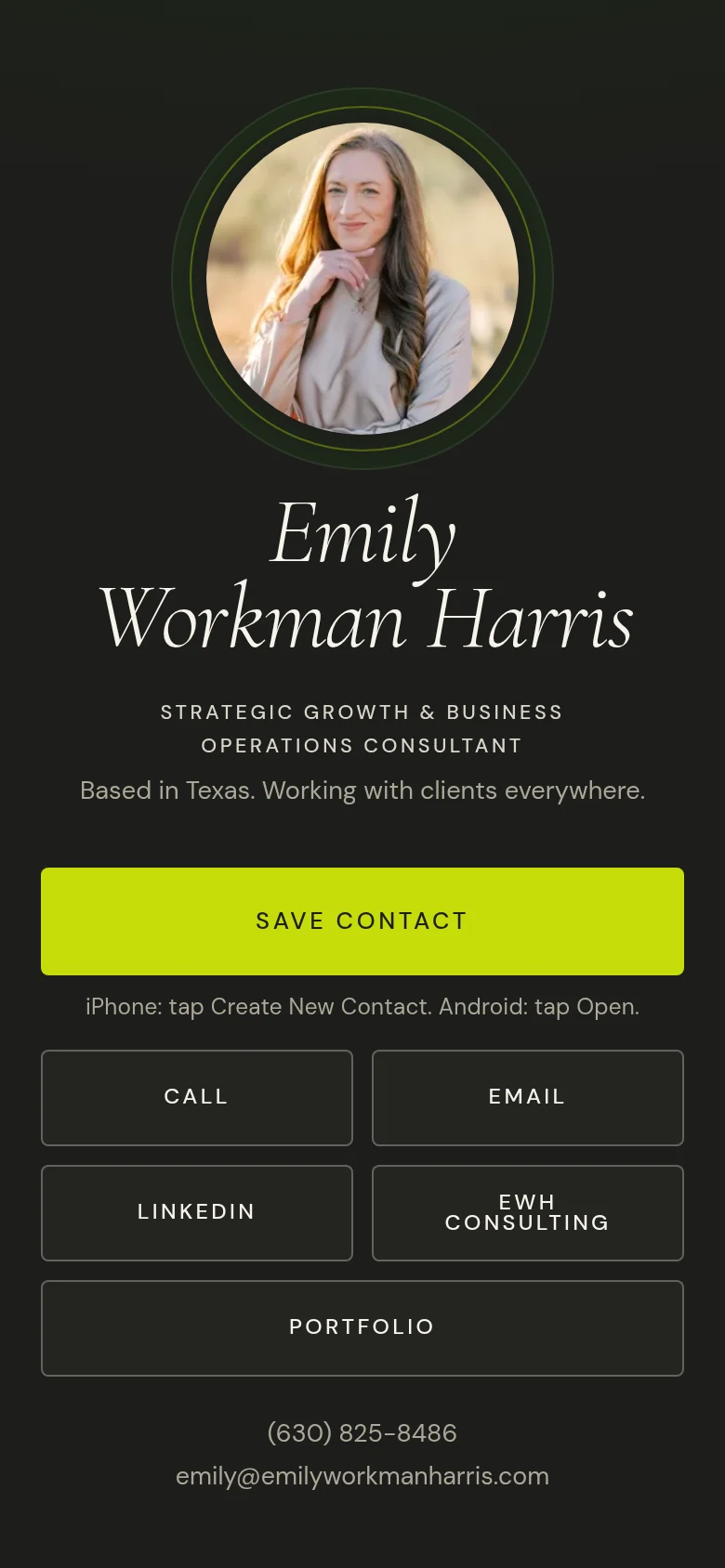
The personal brand experience shown above was developed for TOUCH·POINT’s own use, as a working example of the format. It is not counted as a client engagement. It follows the journey every page is designed around.
- Arrive
Positioning first
A portrait, the name, the role, and where the work happens, readable at a glance.
- Act
Save the contact
The first button saves a contact file, with a short note on how it works on iPhone and Android.
- Explore
Selected work
Labeled links to EWH Consulting and the portfolio, for a visitor who wants to know more.
- Connect
Direct contact
Call, email, and LinkedIn, each one tap away.
Discovery decides the content, the structure, and the design.
A page can be assembled without knowing who it is for. TOUCH·POINT does not begin design until five questions are answered, so every build opens with the same five-phase conversation.
How the person or company should be introduced.
Role, strengths, and the story a visitor should understand. This sets identity, audience, and positioning.
What already exists, and what the page needs to add.
Profiles, sites, and cards already in use, and what each one covers and leaves out.
What goes first, what is left out, and the main next action.
Information priority and messaging for the page, plus the step a visitor should take next.
What the client provides, and what must be created.
Photos, logos, copy, colors, and any professional or contractual limit on what the page can say.
The right starting point.
Scope, starting point, and timing, confirmed in writing before design work begins.
The same for every build
- Discovery frameworkThe five phases above, completed before design decisions.
- Master Content DocumentOne dated, versioned record per client of what is live.
- Save-contact overlayOne interaction pattern, reused across builds.
- TOUCH·POINT brand standardsThe TOUCH·POINT brand system governs the company’s own materials and quality checks. It does not set a client’s palette or type.
Built for each client
- Visual identityDrawn from the client’s own brand, as the HARMAC pages below show.
- Information architectureWhat goes first and what is left out, set by discovery.
- Voice and vocabularyIn the words the client’s audience already uses.
- Content restrictionsAny professional or contractual limit, recorded and applied.
One method, two different client needs.
The same discovery process produced a professional profile and a company presence that do not read alike. Scroll inside each phone to see the full page as delivered, or open it full size.
Cory Seago, HARMAC Energy Services

Scroll inside the phone
View full size: Cory Seago’s professional profile- The need
Help a new contact understand Cory’s role, expertise, and relevance as Director of Business Development at HARMAC Energy Services.
- The design response
His role and a plain promise, “Built on Relationships. Driven by Execution.”, come first, then strengths, then one direct way to connect. The page is meant for the moment after an introduction, while a résumé and LinkedIn keep doing their own jobs. Because his credibility is tied to his company, the page carries HARMAC’s Steel Formation identity.
- What was delivered
A complete professional profile with a save-contact file, built from scratch after several design directions and a set of logo options were reviewed.
 Company Presence
HARMAC Energy Services

Scroll inside the phone
View full size: HARMAC Energy Services’ company page- The need
Organize company capabilities for prospective clients. Buyers, engineers, and operators weigh safety record, technical competence, and reliability first, so the page answers those first.
- The design response
Built on a dated market profile of competitors, buyer titles and concerns, and terms to use and avoid. It presents single-contractor delivery of pipeline and facility construction, salt-water disposal, ROW clearing, and testing and commissioning across the Permian Basin, East Texas, and the Gulf Coast. Deep navy for institutional trust, safety orange from field gear, and steel blue for a platform company, as set out in the Steel Formation brief.
- What was delivered
A company page adapted from the architecture built for Cory’s profile. The shared structure carried over, while the content is institutional, with no personal framing, so the result is a distinct company experience.
A service, not only a set of pages.
Each page depends on the same structure behind it: how a client starts, how content is kept accurate, how pages are produced, and how they are maintained.
- Offer structure
Set by client readiness
Three starting points: a client who brings their own direction and assets, one with a direction to sharpen, and one who needs full discovery and copy written from scratch. Every build is quoted individually. Detailed inclusions, timing, and Care terms are kept on the TOUCH·POINT site.
- Content management
One source of truth
Each client has a Master Content Document: a dated, versioned record of what is live. Revisions are checked against it.
- Production
Shared architecture where it fits
Production and hosting terms are set at the start. Pages reuse proven structure where it suits the client, as HARMAC’s page did.
- Support
Managed updates
Changes go through a managed request process, with optional quarterly Care.
No branded card has been produced, so card design is treated as a future concept rather than a current deliverable.
From an introduction to a way to reconnect.
NFC is the access method. A tap on the card opens the page and offers to save the contact. A QR code is available as an extra service, not a substitute for the card.
A phone touches the card. The page opens, with an offer to save the contact.
What EWH did, and what each client contributed.
EWH built the business and directed every page. Discovery and delivery were run directly with each client.
- StrategyIdentified the opportunity and defined the offer structure, the five-phase discovery framework, and the rate card.
- WritingPage copy developed from discovery and kept in each Master Content Document. AI-assisted drafts were checked against those documents.
- DesignCreated the TOUCH·POINT brand system and set the design direction for each page, including the review of several directions before Steel Formation was chosen.
- DevelopmentDirected AI-assisted production of each page and the save-contact overlay reused across builds.
- Quality assuranceChecked each build and each revision against its Master Content Document before release.
Clients supplied their story and assets through discovery. AI tools assisted with drafting, research, and implementation; decisions were made by EWH.
Capabilities
- Service developmentThe offer structure and delivery process behind every page.
- Discovery and intake designThe five-phase framework used on every build.
- Brand strategy and positioningA professional profile for Cory and a company presence for HARMAC, positioned for different audiences.
- Information architectureWhat each page shows first, and what it leaves out.
- Identifying additional business needsRecognizing when a client’s need extends beyond the page, as it did with HARMAC.
- Production direction and quality assuranceDirecting AI-assisted production and checking every build against its content record.
What is complete, what is defined, and what comes next.
- Completed digital work and business assets
Three pages: the personal brand experience, Cory’s professional profile, and HARMAC’s company presence. Also the TOUCH·POINT brand system, the five-phase discovery framework, a rate card, and a multi-direction design exploration.
- Defined processes
A production and hosting workflow, the save-contact overlay, and the Master Content Document process used for revisions and quality checks.
- Future concepts
Branded NFC cards (none produced yet). Team pages with a page per person, lead forms, and tap tracking (offered, not yet delivered). For HARMAC, a CRM requirements specification was finalized in July 2026; it is a specification only, and implementation has not started.
- Outcomes not measured
Performance not measured Leads, conversions, and contract attribution are not measured. Neither client page runs Google Analytics or Tag Manager, and no client testimonials have been collected.
Working documents (Master Content Documents, the market profile, and the Steel Formation brief) are confidential, so they are described rather than reproduced. Client pages are shown as delivered.
Have a challenge that connects to this work?
Discuss a strategy or digital project
Positioning, brand, websites, and the tools a business runs on.
Explore the service itself
Custom digital experiences for a person or a company, opened by an NFC card.
